
A New Choice for Dementia Prevention
A New Technology-Based Approach to Dementia Care — LTPA Smart Cognitive Training Solution
The number of people living with dementia is increasing rapidly as the global population ages. According to the World Alzheimer Report 2021, the number of people living with dementia is projected to reach 152 million by 2050, while the growing need for dementia care is becoming a significant economic and social burden worldwide.
Among adults aged 65 and older, factors such as chronic diseases, unhealthy diets, and poor lifestyle habits may contribute to changes in brain health, potentially leading to Mild Cognitive Impairment (MCI) or more advanced cognitive decline.
Research also suggests that differences in dementia risk between men and women may be associated with cognitive reserve—the brain’s ability to maintain cognitive function despite underlying damage or changes. Differences in cognitive reserve may contribute to variations in how dementia-related changes are manifested clinically, highlighting the importance of early identification and intervention.
Research from Taipei Medical University: Cognitive Training May Improve Attention in Older Adults with MCI
From November 2020 to March 2022, a research team from Taipei Medical University recruited older adults aged 65 and above with Mild Cognitive Impairment (MCI) or mild dementia from nine community care centers in northern Taiwan.
The research team collected participants’ demographic information and sensory function data, including visual and auditory abilities. Participants had a Clinical Dementia Rating (CDR) score of 0.5 or 1, were independently mobile, and had no physical disabilities.
The study aimed to evaluate participants’ overall attention, attention across different domains, and overall cognitive function following cognitive training. A randomized controlled trial was also conducted to investigate the effectiveness of multi-domain cognitive function training (MCFT) in older adults with MCI and mild dementia, with follow-up assessments conducted over one year to examine its longer-term effects on cognitive function, working memory, attention, and coordination.
The results showed that cognitive training improved overall cognitive function, working memory, selective attention, and coordination in older adults with MCI and mild dementia. No adverse effects were reported during the training period, and the benefits were observed to persist during the one-year follow-up period.
Evidence-Based Research: LTPA May Improve Attention and Help Slow Cognitive Decline
Cognitive training can take many forms, including cognitive stimulation, rehabilitation, and multi-domain cognitive training.
The research team used the LTPA Smart Cognitive Training Solution, an adaptive cognitive training approach designed to activate brain function and stimulate cognitive abilities. This type of training is particularly relevant for older adults with MCI and mild dementia, as previous research has suggested that cognitive training may help slow cognitive decline.
Research Summary
- Participants: 72 older adults (17 male, 55 female)
- Average age: 82.3 years
- Participants with MCI: 91.7%
- Intervention group: 36 participants received multi-domain cognitive training using the SODA APP, focusing on memory, attention, and coordination.
- Control group: 36 participants participated in passive information-based activities, including listening to audiobooks and reading newspapers.
- Study design: Double-blind design, with participants unaware of their assigned intervention.
After one year of follow-up, the results indicated that multi-domain cognitive function training produced meaningful benefits. Following eight weeks of training, three sessions per week, 30 minutes per session, participants demonstrated improvements in overall cognitive function, working memory, selective attention, and coordination.
These findings suggest that incorporating structured cognitive training into community care settings may be a useful strategy for supporting cognitive health and potentially slowing cognitive decline among older adults with MCI and mild dementia. The study also highlights the value of regular activities and ongoing training for healthcare professionals working in community care settings.
Journal: Journal of Global Health
Paper: Efficacy of multi-domain cognitive function training on cognitive function, working memory, attention, and coordination in older adults with mild cognitive impairment and mild dementia: A one-year prospective randomised controlled trial
What Is Mild Cognitive Impairment (MCI)?
Mild Cognitive Impairment (MCI) is a transitional stage between normal aging and dementia, characterized by noticeable changes in cognitive function that do not necessarily interfere significantly with everyday independence.
MCI and dementia share some similarities in terms of diagnosis and identification. However, mild dementia generally involves greater impairment across multiple cognitive domains and can significantly interfere with daily activities.
Maintaining independence and daily functioning among people with MCI or mild dementia is important not only for their quality of life, but also for reducing the burden on families and community care systems.
Activating the Brain Through Technology with LTPA
Research suggests that maintaining regular cognitive and physical training may help support brain health and physical function as we age.
The LTPA Smart Cognitive Training Solution integrates apps, smart devices, Artificial Intelligence (AI), and Internet of Things (IoT) technologies to support cognitive training and physical activity for older adults. Developed in collaboration with occupational therapists, the solution records, tracks, and analyzes training performance, helping caregivers and professionals monitor progress over time.
LTPA combines smart devices with a cloud-based platform to collect comprehensive training data. With AI-supported technology and therapist-designed training programs, older adults can complete short daily cognitive activation and muscle-strength training sessions at home.
LThe LTPA Smart Cognitive Training Solution includes Me-SODA, Me-TAKA, and Me-SPOZ, covering cognitive training, hand-eye coordination, and physical activity.
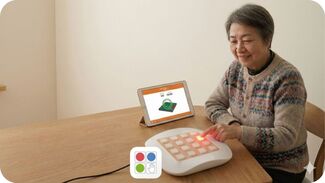
Me-SODA — Cognitive Training System
With just 10–15 minutes of daily training, Me-SODA provides multiple hand-eye coordination training modes designed to engage cognitive functions and maintain hand dexterity.
Training data is recorded after each session, allowing users and family members to monitor progress over time. With seven hand-eye coordination training modes and both single-player and two-player options, Me-SODA also encourages interaction and engagement.

Me-SPOZ — Exercise & Wellness Training System
Build an exercise habit one song at a time. Me-SPOZ offers a variety of exercise programs to keep training engaging and enjoyable. Wearing the dedicated SPOZ gloves allows movement data to be detected and recorded, making exercise performance measurable and trackable.
With guidance from professional instructors, older adults can develop regular exercise habits and stay active as they age.

Me-TAKA — Interactive Cognitive Training
Designed based on principles of brain plasticity, Me-TAKA uses a variety of cognitive games to make brain training engaging and enjoyable.
Through game-based activities, users can train different cognitive abilities while completing challenges and progressing through each game. Its large, simple visual interface is designed to reduce visual fatigue and provide an accessible training experience for older adults.
Based on the principles of non-pharmacological intervention and early preventive action, LTPA combines AIoT technology with evidence-based approaches and data-driven analysis to make cognitive performance measurable and trackable over time.
Through standardized online assessments, training data analysis, and continuous monitoring, LTPA helps identify changes in cognitive performance and provides personalized training recommendations.
Each training session generates measurable performance data, while training records are uploaded to the cloud for long-term tracking. By turning everyday training into measurable data, LTPA helps care teams and families better understand changes over time and adjust training and care strategies accordingly.